17
Didn’t We Already Cover the Rhetorical Situation?
Well… yes. A previous chapter in this textbook did cover the rhetorical situation and its five elements. And it used this picture to help illustrate them:
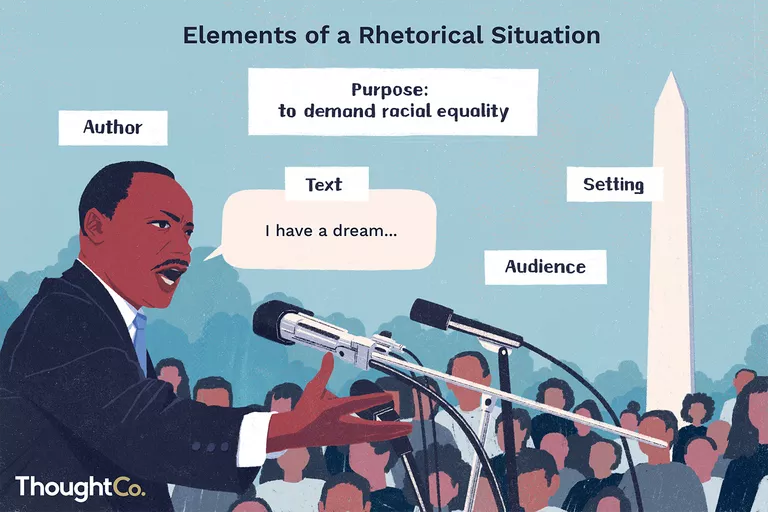
For most, if not all, of your academic career, you’ve been limited to a ‘private’ or ‘limited’ rhetorical situation. Your purpose, audience, setting, and text have been focused on the classroom, the teacher, maybe your classmates, and sometimes (rarely) some external audience, like a presentation to the school or community. When it comes to writing and communication, most students have never/rarely had to deal with ‘the public’, at least not when it comes to school and assignments.
That can make it difficult for student writers to conceive of what changes ‘going public’ might cause to their rhetorical situation. For many of you, the experience that you do have with any sort of communication with ‘the public’ is almost as narrowly defined as the experiences you have with those private/limited situations you’ve found yourself in academically.
Let’s consider what’s the most common/likely way you’ve ever communicated/interacted with ‘the public’: social media. For most of you, that rhetorical situation can be divided into two different categories – typical/likely and atypical/occasional.
I know: that’s a lot of terms. Let’s simplify it a bit. When you post something on social media, like a picture or reel on Instagram or a tweet on Twitter (I don’t care what Elon calls it; it’s always going to be Twitter) or even a post on a personal blog or website (does anyone still use Tumblr?), there’s a chance that you might go viral and anyone might see it – that’s the joy or curse of the internet – but the most likely outcome is that the only people who will see or interact with what you post are the people who follow you: your discourse community.
- Typical/Likely – your followers, friends, family
- Atypical/Occasional – wider audience, going viral, going mini-viral
When it comes to public writing and the public rhetorical situation, we need to start thinking about the audience(s) you might be interacting with. Clearly, if you share something publicly, the most readily obvious audience is the public (sometimes referred to as the general public), as in everyone or at least everyone with access to the internet. And sometimes, aiming/targeting what you’ve written at the general public is the best choice.
But it’s usually not. At least not if you want to accomplish something.
Pause here for a moment and consider this: you’ve chosen an issue that you want to write about publicly. Why wouldn’t you want to target your message about that issue at the general public? What is about that audience that could make that a really ineffective and ultimately unsuccessful choice?
Ultimately, the reason that the general public isn’t likely to be the best audience stems from the purpose behind your public writing. Unlike the typical academic writing that many students are used to, a piece of public writing is designed to achieve some tangible, possibly significant, and public results beyond just getting a grade or passing a class. Accomplishing those kinds of results requires an audience, setting, and text that’s as invested in the topic as the writer and is capable of leading to some kind of real action.
To determine the best ‘public’ space – and format – for your writing, the first step is to think about the relevant public people, groups, and organizations that might care, be concerned, or have any sort of investment in your topic/issue. Since those groups have a stake in the issue, we refer to them as stakeholders.
For Example
The issue you’re concerned with is the impact of generational poverty on the medical and health outcomes of children who grow up in such circumstances. A list of the stakeholders, the people who have connection, concern, and investment in the issue, might look like this:
- Children growing up in generational poverty
- The parents of children growing up in generational poverty
- Medical professionals working in low-income and impoverished areas
- Local/City government
- The Board of Health
- Social Services organizations
- Adults who grew up in generational poverty but have gone on to work and live in more financially secure communities
A quick look at that list shows that there are a variety of stakeholders who would have different reasons for being concerned or invested in the topic and would have different levels of capability when it comes to producing impactful or significant results. For example, the children growing up in generational poverty would care a lot but might not have the power or influence to do much about the situation. On the other hand, the Board of Health might not have quite as much personal investment – but a significant professional one – but would definitely have more power to get things done to address the issue.
Put It Into Action
Make a list of all the relevant, interested, or invested public audiences that connect to your issue. While your list doesn’t have to be exhaustive, it should be as long as possible: the more options you give yourself, the easier it will be for you to narrow the list down and find a public to focus on.
Narrowing down the list of potential publics (audiences) for your writing is one step in the process, but there are other aspects of the public rhetorical situation that need to be considered alongside of choosing an audience. Over the next few chapters, we’ll look at setting, text, and the impact of modern digital “publics” on every aspect of the rhetorical situation.
Media Attributions
- MLK